
Revelation 6:7-8 (reconsidered)

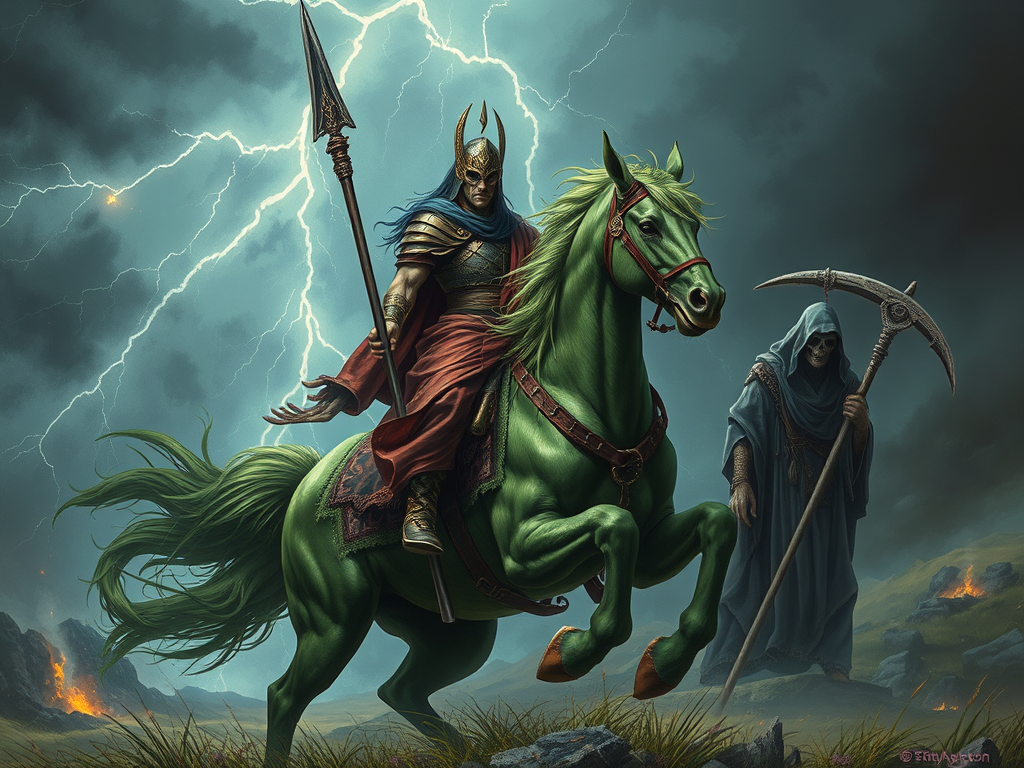
When the Lamb* opened the fourth seal*, I heard the voice of the fourth living creature* say, “Come and see.” I looked and saw a green horse. The rider sitting on the horse is named Thanatos* and Hades* was accompanying him. Permission to control a fourth of the earth was granted to them under the therions* of Gaia*. Permission was granted to put people to death with the sword and to destroy people through extreme poverty and scarcity of food.
Dig Deeper- Click on the words below!
Lamb
John 1:29 (KJV)
The next day, John sees Jesus coming to him, and says, “Behold the Lamb of God, who takes away the sin of the world.”
The Lamb is a metaphor for Jesus, the Messiah. A metaphor is a word or phrase representing something else or symbolic of something else.
Seal
Sphragis-a signet; by implication the stamp impressed (as a mark of privacy, or genuineness) on a book or document or scroll :- a seal. Strong’s Talking Greek & Hebrew Dictionary.
In the first century, when Revelation was written, a person of authority would seal important documents to keep them secret or to authenticate them. Roman law required a last will and testament to be sealed 7 times, as the wills of Caesar Augustus and Emperor Vespasian were. This scroll with 7 seals, appears to be the last will and testament of Jesus, the Messiah.
Living Creature
Zoon-neuter of a derivative of <G2198> (zao); a live thing, i.e. an animal :- beast.
Strong’s Talking Greek & Hebrew Dictionary.
Revelation 4:6-8 (reconsidered)
And round about the throne, were four beasts (Greek word zoon; living creature) with bulging eyes in front and in back. The first beast (zoon; living creature) was like a lion, and the second beast (zoon; living creature) like an bullox, and the third beast (zoon; living creature) had a face like a human being, and the fourth beast (zoon; living creature) was like a flying eagle. Each of the four beasts (zoons; living creatures) had six wings all around them; and the bulging eyes are within the wings (or this could imply the zoon have “eyes to see within” the heart of man like the statement “have eyes to see” which is stated to the called out in all the letters to the churches) . The zoon do not rest day or night. They are continually saying, “Holy, holy, holy, Lord God Almighty, who was, and is, and is to come.”
Thanatos
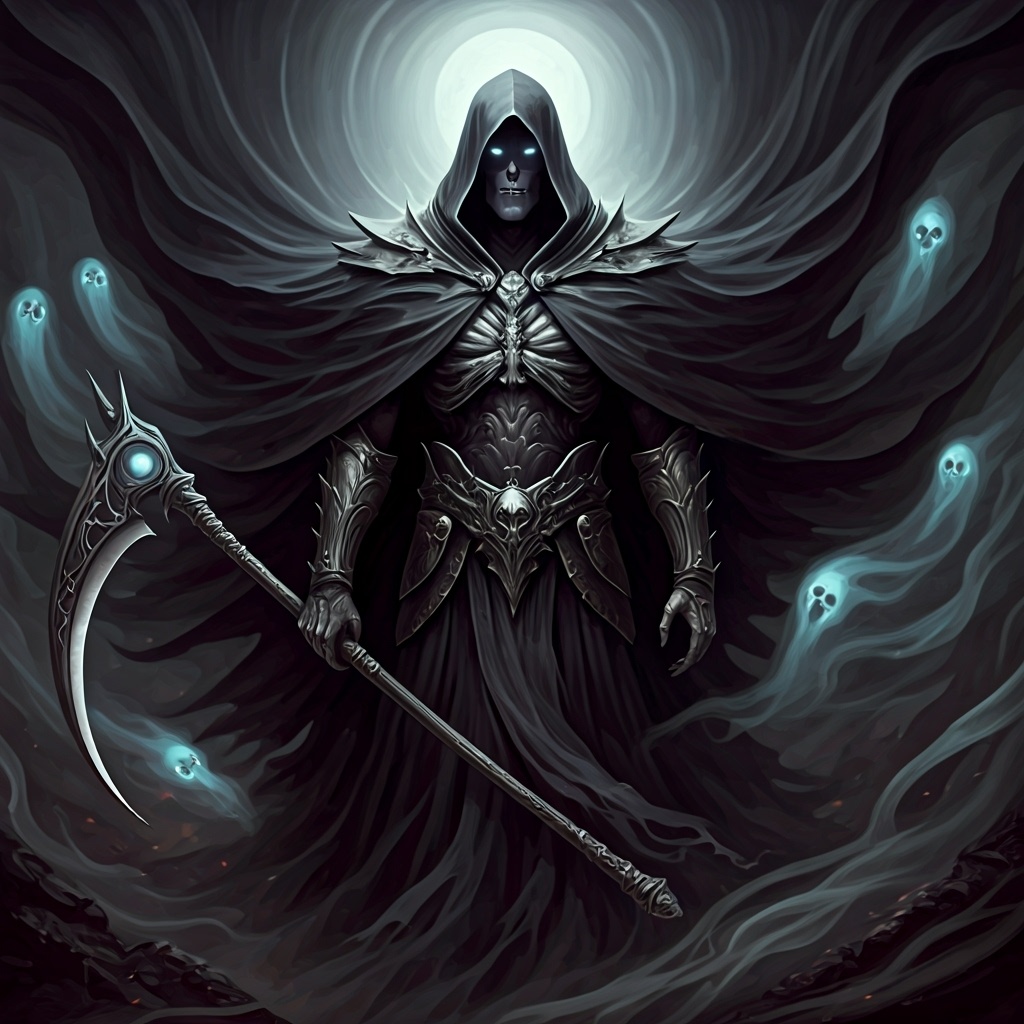
Thanatos was the demonic representation of death in Ancient Greek mythology. He did not play a major part in Greek mythology and rarely appeared in stories because he was mostly displaced by Hades, the god of the Underworld.
Source: https://www.greekmythology.com/Other_Gods/Thanatos/thanatos.html
Hades
Hades, in ancient Greek religion, god of the underworld. Hades was depicted as stern and pitiless, unmoved by prayer or sacrifice (like death itself).

Therion
Therion: diminative from the same as <G2339> (thera); a dangerous animal :- (venomous, wild) beast. Strong’s Talking Greek & Hebrew Dictionary.
It is true that θηρίον (therion) means an animal or beast, but so does ζῶον (zóon). In the book of Revelation ζῶον (zóon) is the word used for the four creatures (cherumim??) associated with the God’s throne.
By contrast, θηρίον (therion) is used of the three “beasts” in Revelation: one of the abyss (Rev 11:7, 12:1-17, 17:8, 20:1, 2), one from the sea (Rev 13:1-10, 16:13, 19:20, 20:10) and one from the land (Rev 13:11-17, 16:13, 19:20, 20:10) who form a kind of unholy “trinity” to oppose God. Theoretically, the words “creatures”, “animals” or “beasts” could be used to translate all of these but we really need to make a distinction between the classes of animals/creatures/beasts by using the actual words used in the Greek text as written.
Gaia

Ge: a primary word; soil; by extension a region, or the solid part or the whole of the terrene globe (including the occupants) :- country, earth (-ly), ground, land, world. Strong’s Talking Greek & Hebrew Dictionary.
In Greek mythology, Gaia (Ancient Greek: Γαῖα, romanized): Gaîa, a poetic form of Γῆ (Gê), meaning ‘land’ or ‘earth’), also spelled Gaea (/ˈdʒiːə/), is the personification of Earth. In the Homeric hymn her conception is more clear and detailed. She is the Mother of the Gods, the goddess that brings forth life and blesses men with children. According to Plutarch: “The name of Ge is beloved to every Greek and she is traditionally honored like any other god”.[29]
 Reconsider: Repent